



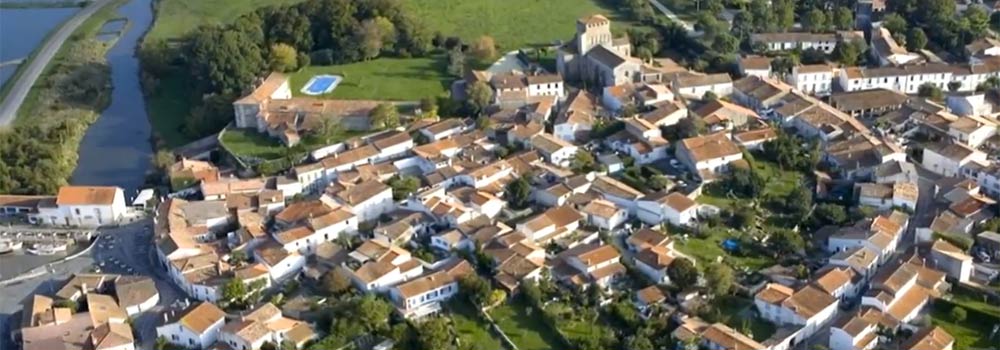
Listed village on the banks of the Seudre river
A former fishing and trading port on the Seudre estuary, Mornac-sur-Seudre is listed as one of France's most beautiful villages. It offers a breathtaking setting for walks, between stone and water. Its white-fronted houses with green or blue shutters line the picturesque lanes, which are a delight to stroll through. Today, Mornac-sur-Seudre makes its living from salt and oyster farming. It's a village you won't want to miss if you're staying at the Royan campsite.
There's a huge heritage to discover here, made up of preserved natural areas, age-old skills and remarkable monuments. In the medieval town, the church of Saint-Pierre is a must-see, with its fortified bell tower and spire. The Halles, once a famous fairground, also date back to the Middle Ages.
The port of Mornac-sur-Seudre
The port of Mornac lies along a channel in the Seudre estuary. It is the departure point for river cruises, as well as kayak and paddle trips through the marshes. Old riggings and small traditional fishing boats are moored here alongside more modern craft. The harbour looks different at high and low tide.
It has a long history: as far back as the Middle Ages, it was used for trade to link the Gironde to La Seudre, thus enabling supplies to Bordeaux to be transported without the dangers of the Maumusson channel. Before the Renaissance, it was also a departure point for the export of salt, grown in the marshes of the commune until the 19th century.e century.
On the bank opposite the quays, an astonishing wooden structure bears witness to the purpose of the port of Mornac in medieval times: it was a lighthouse designed to guide night-time navigation in the channel.
The port of Mornac-sur-Seudre is also home to an old tide mill, whose building now houses a crêperie. A dependency of the château until the Revolution, it was also used as a fishpond by the lords.
Walk from the port of Mornac to the river Seudre
A walk from the port of Mornac to the left bank of the Seudre is an ideal way to discover the oyster marshes. The small dead-end road runs for around 1 km along the channel to its confluence with the Seudre. It can be explored on foot or by bike. The walk is suitable for all levels, with a round trip distance of 2 km. You can reach the port from the Saint Georges de Didonne campsite which is a 30-minute drive away.
The wetlands of the Seudre marshes are a precious natural area of historic importance. The 12,000 hectares of mudflats along the Seudre have been used since the 11th century.e century at least. Most of the salt marshes have been transformed into oyster beds for the Marennes-Oléron oysters. They form a striking mosaic setting that would be a shame to miss.
Take a walk along the channel to observe the many species of birds that inhabit the marshes. At the height of the season, when the village's busy lanes are crowded, this walk offers a pleasant moment of tranquillity. When the tide is out, the channel is quieter than ever: not even the clatter of boat masts disturbs the silence. At high tide, on the other hand, the spectacle is provided by the coming and going of fishing boats and the flat-bottomed boats of the oyster farmers.
Oyster huts and marshes
As you stroll along the channel, you'll soon come across some typical oyster huts. They have the distinctive feature of being open to both the channel and the road. Each has its own pontoon where oyster boats can moor.
The huts become rarer the further along the path you go. The oyster beds follow one another, right up to the oyster farms on the banks of the Seudre. A network of footpaths criss-crosses the mosaic of marshes. The egrets and herons bring the area to life.
The trade of the saunier
These marshes are no longer used for salt production, which was Mornac's main activity until the 18th century.e century. A single marsh is once again in use in the municipality, mainly for remembrance purposes. It is used for a wide range of educational activities and is open to visitors. Its produce is sold in a village shop. The Mornac salt marsh is the only one on the left bank of the Seudre. It is also the southernmost salt marsh on the Atlantic coast. The guided tour is led by the salt-maker, who explains how the basin works and how salt is harvested. The tour lasts around 1 hour 15 minutes.
The rise of the Seudre
A not-to-be-missed event in Mornac, the Remontée de la Seudre takes place every year in early September. This regatta invites all types of craft to sail up the Seudre from La Tremblade to Eguille-sur-Seudre. Several hundred boats gather on the waters of the river to the delight of thousands of visitors.