



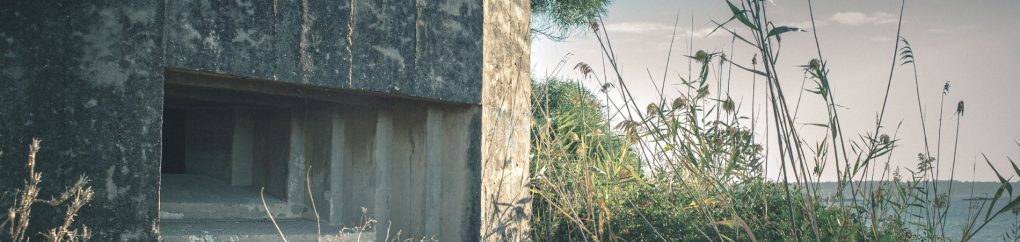
Running along the Côte de Beauté, from La Tremblade to Semussac, in the conurbation of Royan, d’huge concrete blocks are scattered here and there, on the beach or on the side of the dune. These are the blockhouse, a system of fortifications erected by the German army to defend the Atlantic coast during the Second World War. Like the moai on Easter Island, the Royan blockhouse are part of the landscape. Twenty minutes from camping Océan Vacances in Saint-Georges-de-Didonne, These sites, which bear witness to a dark period in history, are well worth a visit during your stay in Charente-Maritime.
The fortress of Royan, from occupation to liberation
Le Royan blockhouse is part of the Atlantic Wall, a fortification built by the Germans along 6,000 km of coastline. This continuous line of fire is made up of artillery pieces pointed towards the sea and sky. The thick concrete shelters, known as blockhouse or bunker, These were used as shelters in the event of bombardment. The city of Royan occupies a strategic position during the Second World War. It provides access to the Gironde estuary and the port of Bordeaux. The occupiers feared a landing there, especially from the United States, which entered the war on France's side in 1941.
That's why they've set up their defensive works. In 1942, Royan became a a major fortress on the Atlantic Wall. Finally, the Normandy landings took place on 6 June 1944, followed by another in Provence on 15 August 1944. Faced with the advance of the Maquis (French resistance fighters) and the Allied armies from Provence, the Germans locked themselves in the Royan blockhouse. The Royan fortress was stormed during the liberation of the Royan pocket in April 1945. After 3 days of intense bombardments and assaults (air, sea and land), the Royan fortress gave way. Admiral Hans Michahelles, commander of the German forces, emerged from his blockhouse and surrendered.
Visit the Royan Blockhaus and the surrounding area
The guided tour of the Royan blockhouse and the surrounding area will give you a better understanding of these structures and how they work... Take a step back in time. bunker to imagine the lives of the soldiers who occupied them. A host of objects discovered inside these shelters are on display on site. In addition to your historical visit, you can explore the seaside resort of Royan. Stroll along the beach, which offers panoramic views of the Atlantic Ocean. Admire the town's major monuments: the central market, the congress centre, the Notre-Dame de Royan church, the carrelets (fishermen's huts on stilts), etc.
When you leave Royan, there are plenty of things to do with the whole family. Surfing on the Côte Sauvage, touring the Ile d'Oléron, climbing the Cordouan lighthouse, exploring the caves at Meschers-sur-Gironde, lounging on the beach at Soulac-sur-Mer, drinking wine in the Médoc, tasting oysters in Marennes... The Royan Blockhaus, an open-air museum The Royan Blockhaus, an open-air museum... Royan blockhouse are part of the magnificent landscapes of the Côte de la Beauté, caressed by the breeze and washed by the waves. They are the witnesses to the tragic events of the Second World War. Preserving these remnants of the war is an important duty of remembrance. It is a tribute to the people who lived through the events of the Second World War, when many French civilians and soldiers from both sides (Allied and Axis armies) perished.
As such, the association La Fortress of Royan and their team of volunteers are working to restore and safeguard these wartime structures that left their mark on France. A visit to the Royan blockhouse not only supports the association's efforts, but also teaches you more about the site's historical importance. It's only 10 km from the Océan Vacances campsite.